Tuesday, September 30, 2025
Memorial of Saint Jerome, Priest and Doctor of the Church
(click here to listen to or read today’s scriptures)
Words (les mots)
In those days ten men of every nationality,
speaking different tongues, shall take hold,
yes, take hold of every Jew by the edge of his garment and say,
“Let us go with you, for we have heard that God is with you.”
In My Fair Lady Eliza sings “Words, words, words! I’m so sick of words!” But I’m not. I love them. And for a week in September Garrison Keillor, who also loves words, celebrated the merging of Latin and French with the Germanic languages into English, accomplished when the Frenchman William the Conqueror invaded the British Isles in 1066. The French-speaking Normans eventually defeated Old English-speaking Saxons at the Battle of Hastings on October 14, 1066 — which had a larger and more pronounced effect on the development of the English language than any other event in history.
At the time, the British were speaking a combination of Germanic-based Saxon and Old Norse. The Normans spoke French. Within the course of a few centuries, the languages blended, and the result was that English became a language incredibly rich in synonyms. The English language has gone on accepting additions to its vocabulary ever since the Norman invasion, and it now contains more than a million words, making it one of the most diverse languages on Earth.
Here’s a fascinating but hardly comprehensive list of words that we take for granted in English but did not exist in England before 1066, sorted by category thanks to Mr. Keillor.
Government (governer from Latin “to steer” or “to rule”)
Allegiance (from ligeance, from Latin for foreign serfs)
Subject (suget – brought under)
King/regal/sovereign/royal/royalty (royalty also includes right to minerals, and then to sale of copyrighted materials)
Crown (corune from earlier coroner – Greek for circle or ring), also corolla, corollary, coronary, coronation, and coroner, who is and was appointed to investigate unnatural deaths in the ruling class.
Court (cort from Latin word for yard)
Courtier/courteous (all present at court with manners fit for a royal court)
Plaintiff (plaintive, lamentation from Latin planctus “beating of the breast”
Evidence (evidere, “obvious to the eye or mind”)
Felon (felon, wicked or a wicked person)
Advocate (Latin vocare, to call for help), also vocabulary, vocalize, voice, voucher, evoke, revoke
Jury (juree, an oath or inquiry)
Judge/judgment/judicial/justice/judicious/judiciary (from jus meaning law and right)
Gourmet (gromet, a wine-taster’s assistant)
Gourmand (same root but with sense of moral disapproval, as in glutton or gluttony)
Supper (super – to take one’ evening meal)
Dinner (disner – from Latin to break a fast)
Beef (boef – bull)
Mutton (muton – sheep)
Pork (porc – from Latin porcus)
Cutlet (cotelette – little rib
Roasted (rostir – cook over a fire, cook in an oven, later to ridicule or criticize)
Grill (French word for “grate”)
Salad (salade – from Latin salata, that which is salted – early dressings were comprised of salt water)
Salsa, sauce, saucy and salary (from sel – “worth his salt”). Salt provided part of many salaries, since it was very precious.
Literature (from lettres)
Pen (from penne – a feather with sharpened quill
Ink (from enque)
Poet (from poete from Greek poiein to create and poete maker) referring to all creative literature
Tragedy (from tragedie via Latin from Greek tragoidia – goat song
Mystery (from mistere) – mystic presence or hidden religious symbolism
Comedy (from Old French via Latin from Greek – revel singer
Comedian (writer of comic plays, then a joke-teller in front of an audience)
Journal (from jurnal – “belonging to a day” – at first times of daily prayers, then a diary, then newspaper titles (journalism)
Soldiers (from soldier from Latin souled, for “a gold coin of the Roman Empire”
Battalions/battle (from bataille from Latin battualia “to beat”, military or gladiator exercises
Sergeant (from sergent)
Siege (from sege, from asegier) original English meaning, “to sit down in front of”
Army/armor/armory (from armer to supply with weapons)
Navy/navigation (from navis – ship)
Traitor/treason (from treisoun – “handing over”)
War (from Old English werre, “worse, confusion, discord.” Modern German krieg)
Defeat/retreat (from retraiter – to pull back)
Treaty (from traite)
Peace (from paix from Latin pax)
Religion (originally “life under monastic vows,” from Latin – “obligation, bond, reverence”)
Pray (preier, to ask earnestly). A “preire” is an entreaty of uncertain outcome, also the root for precarious, deprecate, postulate, expostulate
Preach (prechier, to “proclaim” from Latin praedicare – to pre-declare
Saint (seint from Latin sanctus – holy, also sanctify, sanctity, sanctimonious)
Sanctuary (sanctuaire – church where fugitive was immune from arrest)
Mercy (merci – formerly pity, now “thank you”, also merciful, merciless)
Pilgrim/pilgrimage (pelegrin – foreign from Latin for abroad), also peregrinate – travel by foot)
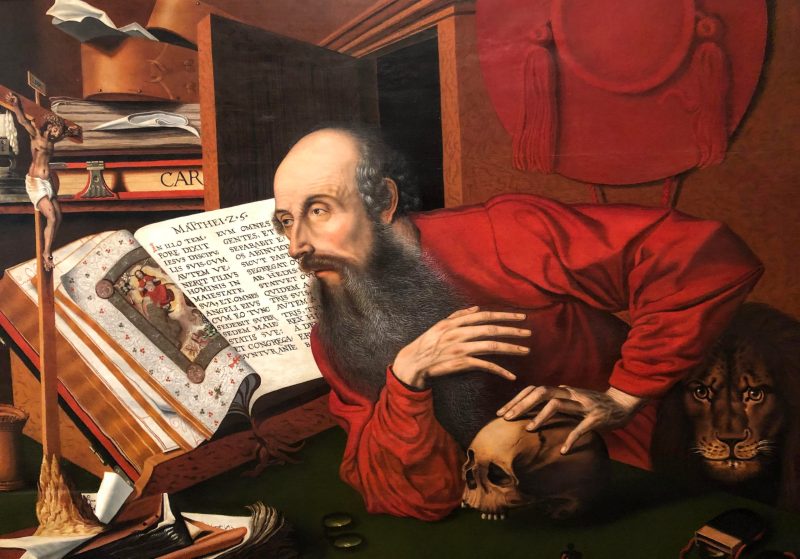
Three hundred years after Jesus’ resurrection, Saint Jerome translated the Bible’s Old Testament from Hebrew and its New Testament from Greek into the Latin “Vulgate,” which became the standard text in western churches for a thousand years. Of course he too was a lover of words and is the patron saint of librarians, translators and Biblical scholars.
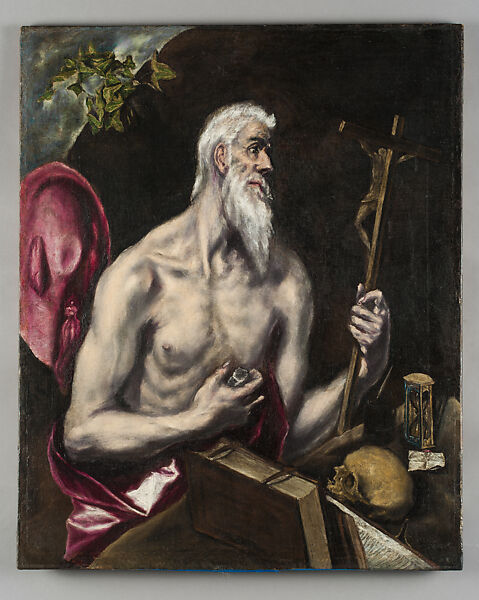
At the Blanton Museum of Art two weeks ago we saw three portraits of Jerome, although the one we saw there in 2019 and admire the most (see above) no longer seems to be there. One of El Greco’s portraits of Jerome was there, however (“Saint Jerome as a Penitent”), and it stopped me in my tracks. I couldn’t help but get lost in his eyes. El Greco must have felt the same way.
Let us go with you, for we have heard that God is with you.
(Zechariah 8, Psalm 87, Mark 10, Luke 9)
(posted at www.davesandel.net)
#
