Twenty-ninth Sunday in Ordinary Time, October 19, 2025
(click here to listen to or read today’s scriptures)
Give me a hand
Moses was 80 years old. He spoke to Joshua, his much younger right-hand man, as they watched their enemies the Amalekites approaching them with swords, chariots and armor.
(These are not, by the way those Amalekites mentioned in Genesis 14, who were named by virtue of their geography, not their ancestor, long before the birth of Esau.)
Pick out certain men,
and tomorrow go out and engage Amalek in battle.
I will be standing on top of the hill
with the staff of God in my hand.”
So Joshua did as Moses told him.
A grandson of Esau, Amalek and his tribe had been watching the sons of Jacob approach the land they had claimed and cultivated for themselves. They would not give way; they prepared for battle. Joshua and his army marched out to meet them.
Moses climbed to the top of the hill with Aaron and Hur (no relation to Ben-Hur).
As long as Moses kept his hands raised up,
Israel had the better of the fight,
but when he let his hands rest,
Amalek had the better of the fight.
Moses’ hands, however, grew tired.
Leaders have watched the front lines of battle from hills in the rear since the beginning of war. In the Civil War, Lee and Longstreet, Grant and Sherman all wrote in memoirs of hilltop vantage points, placed so they could see the big picture and direct their divisions to turn, push forward or retreat.
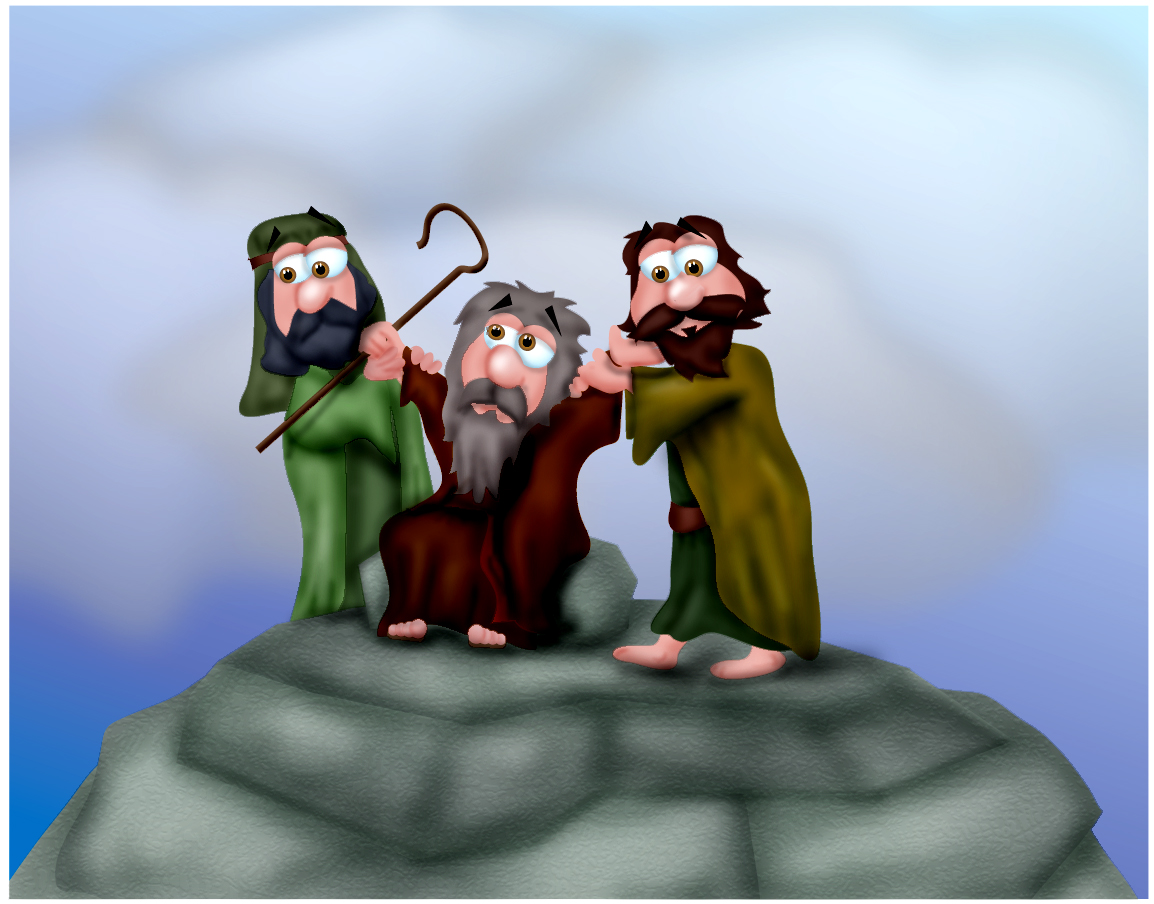
“Give me a hand,” Moses said to Aaron his brother, and Hur his friend. And they did. First they found a rock and put it in place for him to sit on.
Then Aaron and Hur supported Moses’ hands,
one on one side and one on the other,
so that his hands remained steady till sunset.
The battle belonged to the Lord.
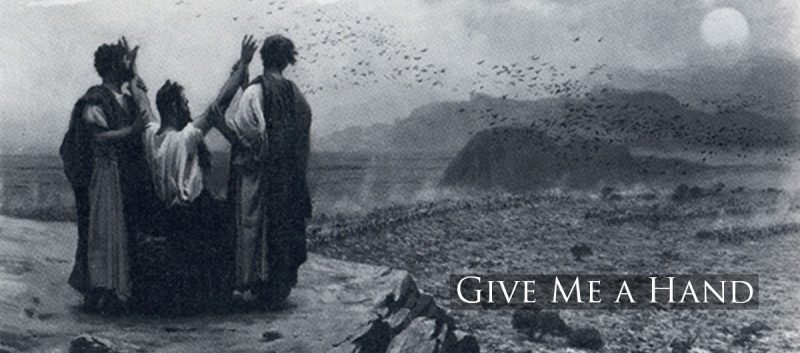
Joshua mowed down Amalek and his people
With the edge of the sword.
Amalek was killed. His army was defeated and left the field.
Then the Lord said to Moses, “Write this on a scroll
as something to be remembered.
Make sure that Joshua hears it,
because I will completely blot out
the name of Amalek from under heaven.”
Here is what the Lord told Moses to write:
Because hands were lifted up
against the throne of the Lord,
the Lord will be at war against the Amalekites
from generation to generation.
The victory belonged to the Lord, and to Joshua, Moses, Aaron and Hur representing all the Israelites who had so recently been liberated from Egyptian slavery. But I am struck again by the near certainty that one generation will not see the completion of God’s promise. A thousand years will pass before the name of Amalek is “completely blotted out.”
- 400 years later King Saul will defeat the Amalekites once again, but he does not completely destroy them as he was commanded. Their name is not yet blotted out.
- David becomes king, Solomon succeeds him and builds the First Temple dedicated to worship and preservation of Israel’s relation with Yahweh.
- Nebuchadnezzar destroys Solomon’s temple and carries the Israelites off to seventy years of exile in Babylon.
- Persia (Iran) defeats Babylon and extends physical, emotional and spiritual aid to the Jewish people returned to their land from exile.
But the dregs of Amalek’s cup are still in God’s throat.
Soon Amalek’s descendant Haman also comes to hate the Jews. An important official in the Persian (Iranian) court of King Xerxes I, Haman plots to hang his insolent, stubborn, disobedient and Jewish opponent Mordecai. But just as Moses rose up in the Egyptian royal court, so the king’s Queen Esther (Mordecai’s Jewish orphan cousin) changed the king’s mind.
After Haman was hanged on the scaffold he had built for Mordecai, we find no more mention of Amalekites in the Bible. Their name is “blotted out.”
Or is it?
From enemies who could be seen and fought, these Amalekites have become a timeless symbol of opposition, a personification of chaos against order, of barbarism vs civilization. They are the “metaphysical” nation that symbolizes anything that threatens the Jewish people. From Haman to Hitler, you might say. They are to be feared, and they are to be fought.
I lift up my eyes toward the mountains;
Whence shall my help come from?
My help is from the Lord,
Who made heaven and earth.
Beside our revulsion at the moral depravity in the midst of all these tales of victors and vanquished, there remains God’s presence – evident on the hill with Moses, in King Saul’s court when Samuel imposed God’s judgment on Saul’s house, and in the night visions of Queen Esther as she prayed before approaching her king. Can we take it ALL in?
All Scripture is inspired by God
and is useful, so that one who belongs to God
may be competent and equipped for every good work.
So proclaim the Word, whether it is convenient or inconvenient,
To patiently convince and encourage all.
God sees his creation – the world and all of us – from His infinite, heavenly perspective. We must struggle with our own points of view, limited by time and space, with the certainty that none of our lives will span more than three or four generations.
Should we even try? Yes, we must, because otherwise our fear of each other and grasping for control swallows us up. Paul’s admonition to be patient is all important. Henri Nouwen, a twentieth century observer, writes of our problem with power, referring to examples many generations after the death and resurrection of Jesus:
Every time we see a major crisis in the history of the Church, such as the Great Schism of the eleventh century, the Reformation of the sixteenth century, or the immense secularization of the twentieth century, we always see that a major cause of rupture is the power exercised by those who claim to be followers of the poor and powerless Jesus. What makes the temptation to power so seemingly irresistible? Maybe it is that power offers an easy substitute for the hard task of love. It seems easier to be God than to love God, easier to control people than to love people, easier to own life than to love life.
We will not know history like God knows it. We are not privy to the Tree of Life. We do not and will not live forever in the Garden. But we can love God, love people and love life with every second of every day of every year that we are here.
Jesus spoke about the necessity for his disciples to pray always and not become weary.
Will not God then secure the rights of his chosen ones
who call out to him day and night?
Will he be slow to answer them?
I tell you, he will see to it that justice is done for them speedily.
Jesus has a caveat, however. He knows our faithfulness is fickle, and he warns us to be awake and watchful in our own hearts.
But when the Son of Man comes, will he find faith on earth?”
(Exodus 17, Psalm 121, 2 Timothy 3, Hebrews 4, Luke 18)
(posted at www.davesandel.net)
#
