Wednesday, January 28, 2026
Memorial of Saint Thomas Aquinas, Priest and Doctor of the Church
(click here to listen to or read today’s scriptures)
Snow falling on the Appian Way
The LORD of hosts has this to say:
It was I who took you from the pasture
and from the care of the flock.
I have been with you wherever you went,
and I have destroyed all your enemies before you.
And I will make you famous like the great ones of the earth.
Today in the prison yard at Danville, preparing for weddings I look up. There’s another snowflake, falling softly from the sky. Soon it will touch the earth, and melt, water the world awhile and then rise again to fall, again, its own self each time, fearfully and wonderfully made.
Yesterday I made my weekly date with Mounjaro, a simple shot into my tummy, painless and effective. I’ve lost a lot of weight. Lab results continue to please Dr. Deem. He is grateful I took his advice three years ago and spent some money. Maybe my body will last awhile longer.
I know there’s a balance between using modern meds to stay alive, on the one hand, and settling into a more natural death, whenever that might come, letting it come with less interference, less “resuscitation.”
Death interrupted? Or death waited for and welcomed? Here’s James Joyce, writing from his youth, in Portrait of the Artist as a Young Man:
He was alone. He was unheeded, happy, and near to the wild heart of life. He was alone and young and wilful and wildhearted. … Welcome, O life! I go to encounter for the millionth time the reality of experience and to forge in the smithy of my soul the uncreated conscience of my race.
He also wrote, in the same book:
You can still die when the sun is shining.
Actually Joyce didn’t write that, at least I couldn’t find it in my Kindle copy. It didn’t sound quite right to me, so I searched. Someone put that on the Goodreads page without guilt –maybe they made it up themselves. But anyway, Joyce wrote convincingly and joyfully out of his youth, once he was freed from Irish Catholic dogma and someone looking always over his shoulder. I wrote my own poems of joy about youth too, when I was young. Now I look for poetry and joy withi the advent of my last days (or years). As did Joyce, as do we all.
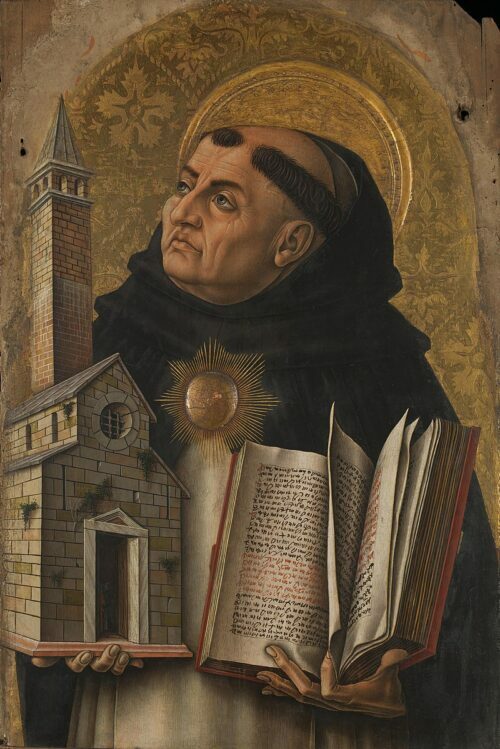
Thomas Aquinas included. In his own 13th century Thomas had to liberate himself, first from his worldly, wealthy family and their plans for him, and then from jaded professors caught in the Platonic Christianity of their church and university. With his dazzling mind and patient, pleasant spirit, Thomas peopled Plato’s cave full of shadows and firmed them up with flesh. Aristotle opened Aquinas’ mind to the world around him, and he never closed it again. In his biography of Aquinas, The Dumb Ox, G. K. Chesterton caught this situation with his incomparable prose.
Aquinas felt subconsciously that the hold of his people was slipping away from the solid Catholic doctrine and discipline, worn smooth by more than a thousand years of routine … For some time the Catholic church had been too Platonist to be popular. It needed something like the shrewd and homely touch of Aristotle to turn it again into a religion of common sense.
Aquinas participated in hundreds of debates and wrote thousands of pages of philosophy and theology, taking apart false dogmas and strengthening right ones. Then when he was 48 or 49, during a Christmas Eve mass he had a vision and stopped writing altogether. Chesterton described that moment:
Soon his friend Reginald asked him to return to his regular habits of reading and writing, and following the controversies of the hour. He said with a singular emphasis, “I can write no more.” He was silent for awhile. Reginald approached the subject again. “I can write no more, I tell you. I have seen things which make all my writings like straw.”
“What I have written is nothing but a pile of straw.” Thomas did accept a papal mission to a council in Lyon in the coming weeks, but on his journey there he stopped to visit his sister, where the “dumb ox” was stricken with an unknown malady, and “his strange end came upon him with great strides.” At the monastery where he was taken, he asked to have The Song of Solomon read through to him from beginning to end. Aquinas was a poet (who wrote poems) as well as a theologian and philosopher.
Aquinas rose to obey his pope in automatic obedience, as a soldier rises, but we may fancy there was something in his eyes that told those around him that obedience to the outer command would not in fact frustrate obedience to some more mysterious inner command, a signal that only he had seen … there must have been a moment (as he lay in his deathbed) when men knew the thunderous mill of thought had stopped suddenly; and that after the shock of stillness that wheel would shake the world no more; that there was nothing now within that hollow house but a great hill of clay; and the confessor, who had been with him in the inner chamber, ran forth as if in fear, and whispered that his confession had been that of a child of five.
Oh! That life we each live from dust to dust, all our days like snowflakes melting into the earth, to which we too eventually return.
And then the judgment. Come, Lord Jesus.
The seed is the word of God, Christ is the sower;
all who come to him will live forever.
(2 Samuel 7, Psalm 89, Mark 4)
(posted at www.davesandel.net)
#
